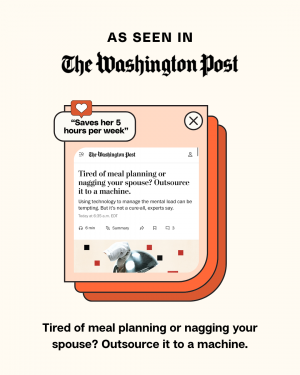
When The Washington Post recently explored how families are turning to artificial intelligence to lighten the invisible labor of running a household, we were thrilled to see Ollie at the heart of the conversation.
But this isn’t just a story about one app getting press. It’s part of a much bigger shift that matters for every busy parent.
The Mental Load Is Real — and It’s Costing Families Time, Energy, and Joy
For most families, managing meals is just the tip of the iceberg. Every day brings a mountain of invisible work: planning dinners that everyone will eat, remembering school spirit days, juggling grocery budgets, managing dietary restrictions, and trying to eat healthier — all on top of full-time jobs and everything else life throws at us.
Sociologists call this “the mental load.” And it’s enormous. Studies show that the unpaid labor of managing family life represents nearly half of all productive human time. Historically, women have shouldered most of that load — and it’s a major contributor to burnout, stress, and relationship tension.
As one mom told The Washington Post, planning dinners used to trigger daily text arguments with her husband. Once they started using Ollie to plan meals together, those friction points disappeared.
“We don’t have that little tension point anymore,” she said. “It’s given us both time to think about other things.”
That’s the real promise of AI at home: not just saving time, but reducing friction and giving families back their mental space.
Why AI Belongs in the Kitchen (and Beyond)
Most conversations about AI focus on the workplace — how it helps us code faster, write better, or automate office tasks. But there’s another frontier: the home.
When families use tools like Ollie, they’re not just outsourcing grocery math or recipe hunting. They’re reclaiming hours every week. They’re freeing up headspace to think about things that matter more than “Is it tacos or spaghetti tonight?”
And this is just the beginning. Research suggests automation could reduce the time spent on domestic tasks by nearly 40% within the next decade. Grocery shopping — the most automatable task of all — is already transforming with tools like Ollie that plan meals, build shopping lists, and even help order ingredients online.
Our Mission: Do the Whole Job, Not Just Part of It
At Ollie, we’re not trying to replace parents — we’re trying to give them their time, their energy, and their peace of mind back.
That’s why Ollie doesn’t just suggest recipes. It learns what your family likes (and doesn’t). It adapts to dietary needs. It helps you use what’s already in your fridge. It even connects to services like Instacart and Amazon Fresh to get groceries to your door — because meal planning isn’t really solved until dinner is on the table.
Our vision goes beyond meal planning, too. We believe AI should eventually help manage the whole mental load of family life — the calendar chaos, the permission slips, the “what’s for dinner?” texts — so you can focus your energy where it belongs: with the people you love.
A Moment to Celebrate — And an Invitation
We’re honored that The Washington Post featured Ollie as part of this new era of AI for families. But more than that, we’re excited about what it means: families everywhere are recognizing that the mental load isn’t just “part of the job.” It’s a problem worth solving — and technology can help.
If you’re ready to see what it feels like to have one big piece of that mental load lifted, try Ollie today.
Download Ollie and let us do the heavy lifting of meal planning for you.